Key Takeaway
Jellyfish gives you engineering dashboards and ROI frameworks. Chrono ties engineering time to real costs and tax credits, flags delivery risk as it happens, and adds capacity when you need it. Jellyfish produces estimates. Chrono produces evidence you can put in front of a board.
Your CFO wants to know what the engineering budget bought. Velocity charts don’t answer that. Neither does deployment frequency.
Jellyfish and Chrono Platform both promise to close that gap, and they do it differently. Jellyfish measures engineering activity and maps it to business goals. Chrono connects the same activity to dollars: cost centres, budgets and SR&ED tax credits.
This article compares them across ten areas. Where Jellyfish is the better fit, we say so.
Chrono Platform vs Jellyfish at a glance
| Feature/Platform | Chrono Platform | Jellyfish |
|---|---|---|
| AI-Powered Automation | Specialized AI agents | No |
| Audit-Ready R&D/SR&ED Compliance | Built-in & audit-ready | No |
| Engineering ROI Insights | Connects time + cost to business KPIs | Time allocation views |
| Real-Time Delivery Risk Alerts | Risk Sentinel Agent | Project lag only |
| Zero Manual Time Attribution | No timesheets | Jira/Git mapping |
| Audit-Ready Documentation | Auto-generated packages | No |
| Executive-Ready Dashboards | AI-written summaries & ROI reports | Strategy dashboards |
| Plug & Play Integrations | Jira, GitHub, Slack, Calendar & more | Limited APIs |
| Built for SMBs | Absolutely | Enterprise-focused |
| Developer-Friendly Experience | No micromanagement, full transparency | Seen as top-down |
| Transparent, Flexible Pricing | From $20/user/month | Quote-only |
1. Does either platform automate SR&ED?
Chrono does. Jellyfish doesn’t, and this is the sharpest difference between them.
For Canadian companies, SR&ED is worth 35% refundable on the first $3 million of qualified expenditures. Miss eligible hours or file thin documentation and the money is simply gone.
How Chrono collects the evidence
No timesheets. Chrono reads Jira, Git, calendars and payroll, and builds the record from what’s already there.
That matters because manual tracking is expensive before it’s inaccurate. A 2025 analysis by Early put timesheet overhead at roughly 25 minutes per person per day. For a team of 10, that’s 1,040 hours a year, or about $41,600 in administrative time.
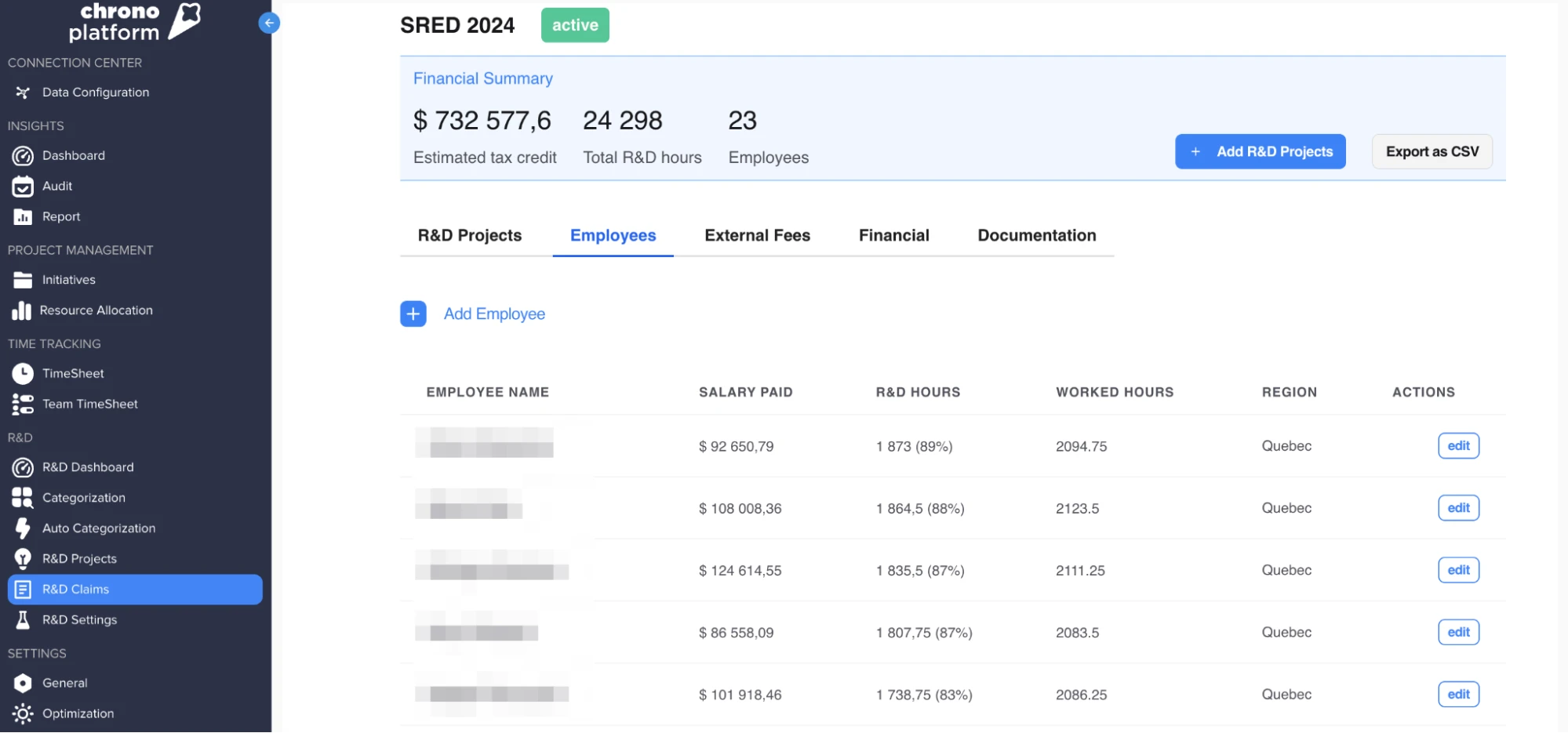
Every activity gets a category tag, a contributor, a project link and a timestamp. The record builds as the work happens instead of under year-end pressure, which is exactly the distinction the CRA draws when it reviews a claim.
Forecasting credits mid-year
Because tracking is continuous, you can see the accrual as it builds and tell finance what the credit will be before the year closes. Our clients recover up to 40% more in credits, almost entirely because qualifying activity stops slipping through.
Where Jellyfish stops
Jellyfish does software capitalization reporting and connects engineering output to business goals. That’s real financial alignment and it’s useful.
It doesn’t automate SR&ED or US R&D credit claims. If your CFO is asking about direct tax recovery, general performance metrics won’t answer the question.
2. How is time categorized?
Chrono runs a rules engine. Jellyfish runs fixed categorization.
Manual tagging fails predictably. Research has found that 94% of spreadsheets used in business decisions contain errors, and engineers resist logging tasks, which leaves managers with gaps and misclassified entries.
Reconstructing time from real records
Chrono pulls from the tools your team already uses and reconstructs where time went from commits, tickets and calendar entries.
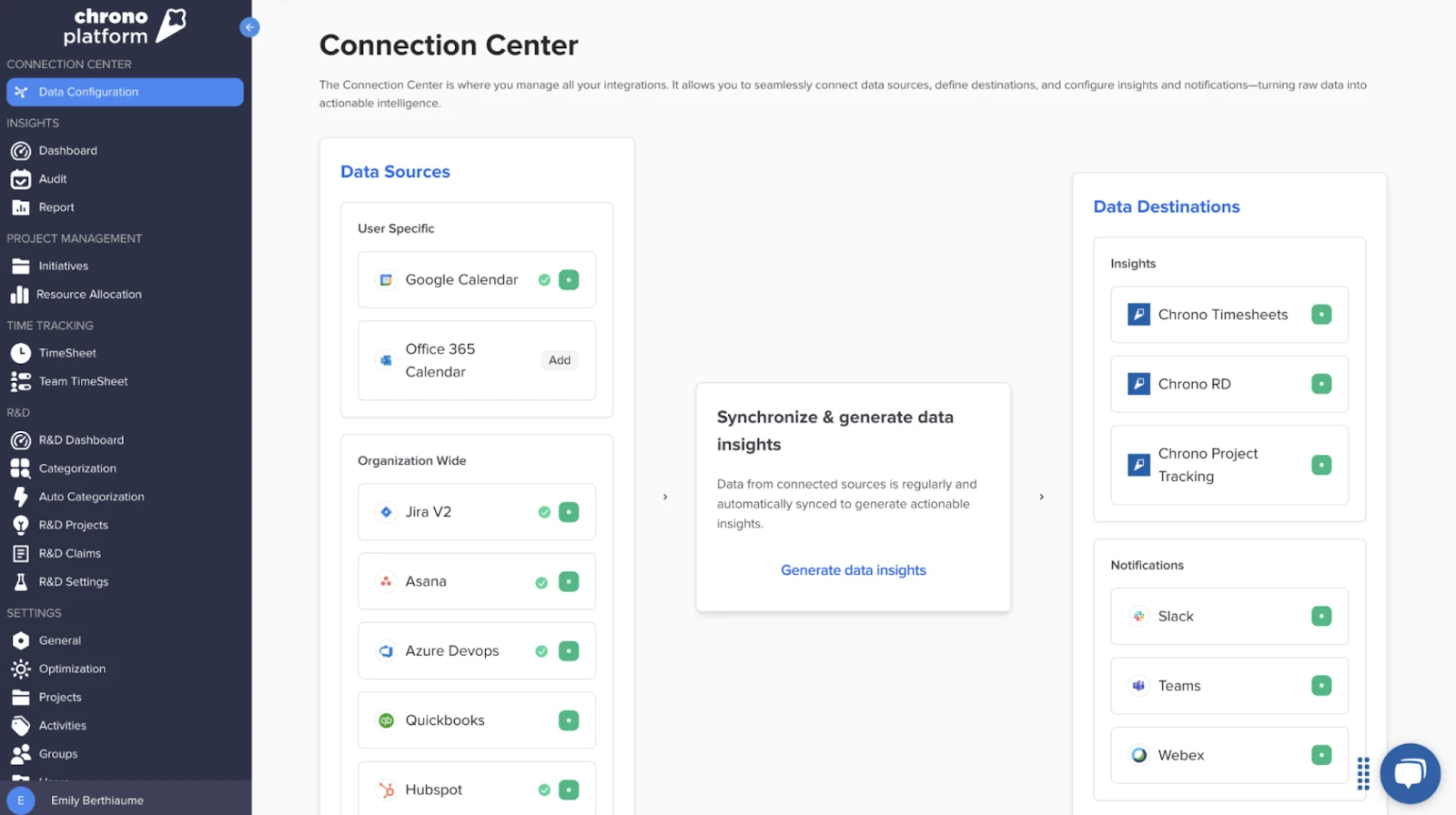
That removes the self-reporting problem entirely. You get an honest distribution of effort across coding, meetings and overhead, which makes the finance conversation a lot shorter.
Rules that change without breaking history
Tax rules move. The One Big Beautiful Bill Act reinstated expensing for domestic R&D under section 174A, and work that was classified one way last year may need reclassifying this year.
Chrono applies new rules retroactively without recoding past entries. You reclassify once and the history stays consistent.
Where Jellyfish stops
Jellyfish’s DevFinOps product generates automated capitalization reports and supports Section 174 compliance, showing how engineering time splits across new initiatives, roadwork and tech debt. For US tax purposes that’s genuinely valuable.
The limitation is that categorization is fixed. When priorities or rules change, there’s no way to rebuild or reclassify what’s already recorded.
3. Which one catches delivery risk earlier?
Chrono flags risk continuously. Jellyfish flags it on planning cycles.
Late delivery isn’t only a schedule problem. According to Supply Chain Digital, delays can erode up to 20% of a company’s revenue.
Continuous signals instead of status updates
Chrono watches the tools your team works in and flags sprint slowdowns, stalled reviews and budget drift as they happen, not when someone writes them into a status report.
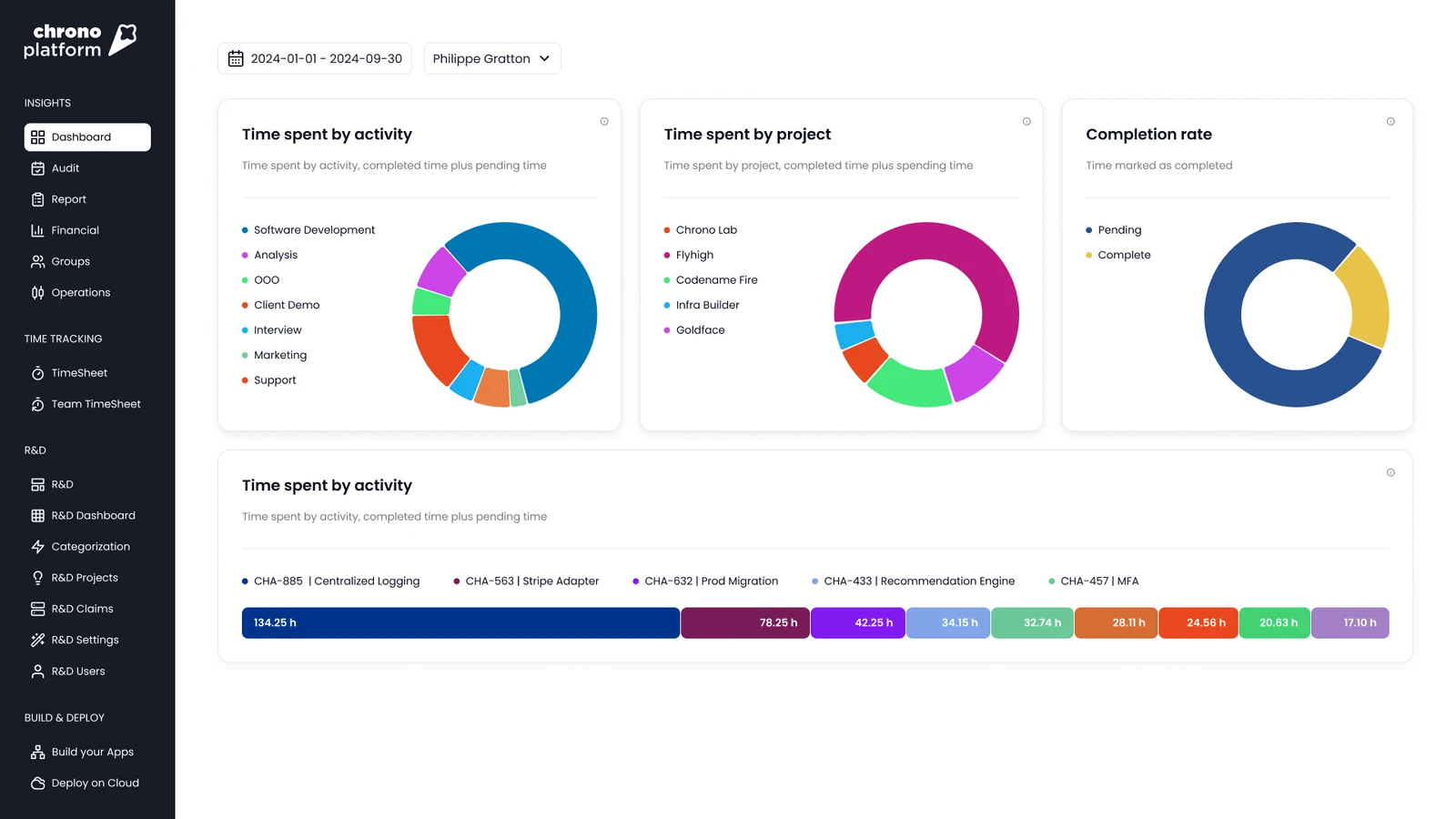
Each alert carries a timeline and a cost impact, so a risk shows up as a number rather than a feeling.
One view for engineering and finance
Developers, managers and finance leaders see the same live data. Blockers, over-capacity teams and budget overruns are visible to everyone at once, with nobody reconciling two systems to find out which is right.
Where Jellyfish stops
Jellyfish’s Team Pulse dashboard covers team health, blockers and forecasted risk, with automated alerts and scenario planning. At sprint and epic level it works well.
The catch is that it depends on how the dashboard is configured and where you are in the planning cycle, and it doesn’t connect to financial systems. It’s good for standups. It’s weaker for catching a problem the day it starts.
4. Can either one prove engineering ROI?
Chrono traces it to individual activity. Jellyfish estimates it at the framework level.
Velocity and deployment frequency don’t tell you whether engineering time produced revenue or recovered a tax credit. Those are the two answers finance actually wants.
Tying effort to financial results
Chrono captures hours, tasks and delivery milestones, then links them to real costs, R&D eligibility and budget lines.
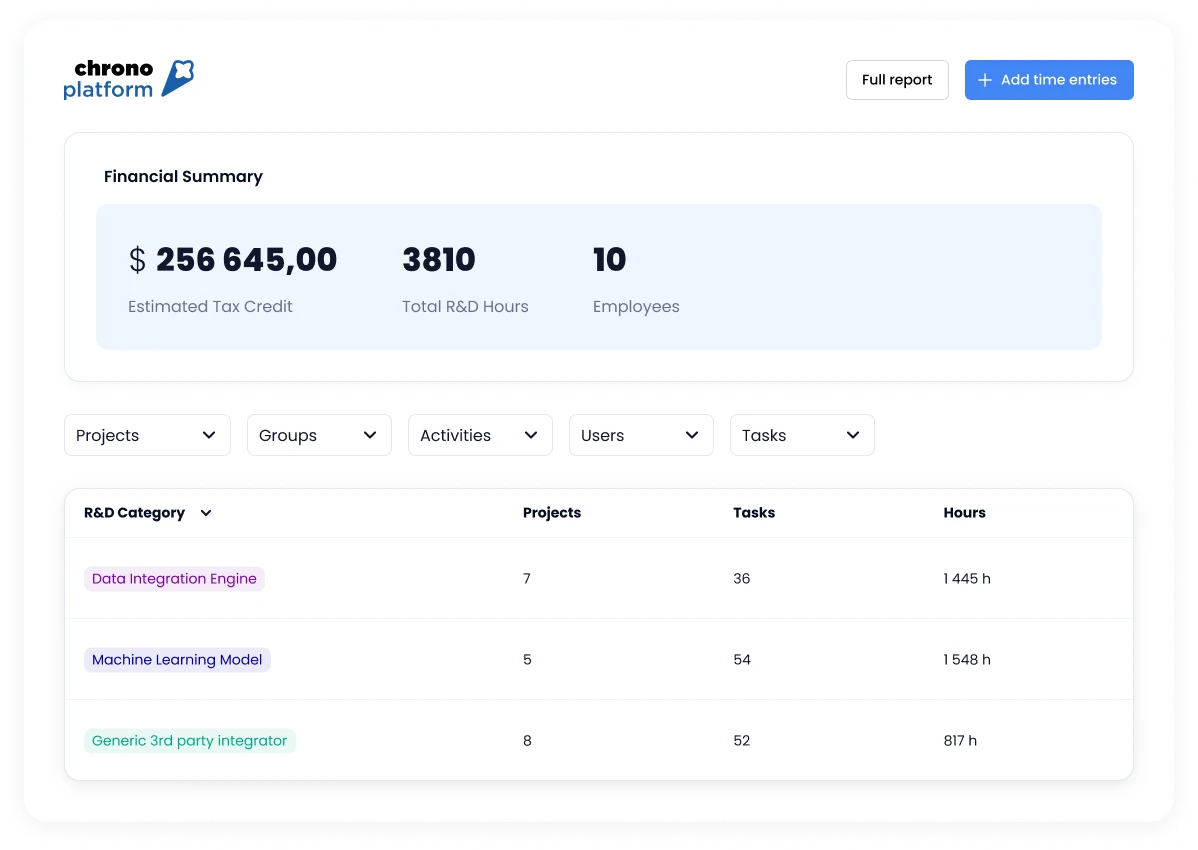
A project stops being “done” and becomes an investment with a return attached, whether that return is new revenue, reduced overhead or a SR&ED credit. That’s the level of detail a board conversation needs.
Tracking it as it happens
Live dashboards combine delivery and financial data across the lifecycle, so you can see budget burn and effort distribution while there’s still time to move people.
Where Jellyfish stops
Jellyfish approaches ROI through frameworks: calculators, maturity models and prioritization insights that help leaders estimate the value of better throughput or less reporting overhead.
Those estimates stay at a high level. Individual activity doesn’t trace back to an audited financial outcome. If you’re defending millions in budget, an estimate is a weaker instrument than a trace.
5. How do squads stay tied to business outcomes?
McKinsey’s 2024 Digital Transformation Report found 68% of software projects fail because departments aren’t aligned.
Chrono lets you hand a whole initiative to a squad and still watch budget, ROI and delivery against business outcomes.
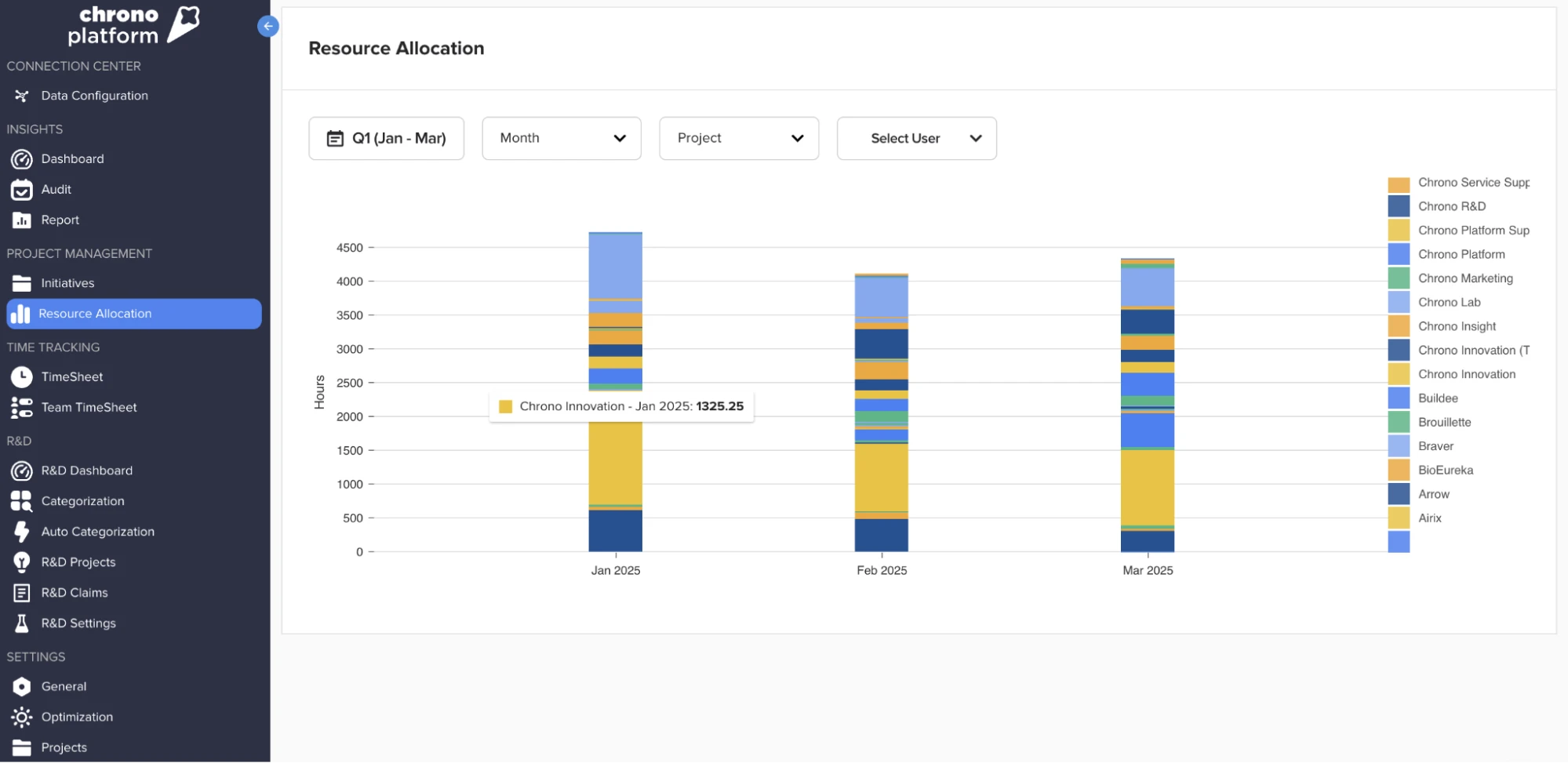
You see more than task completion. You see whether the squad’s work moved feature adoption, revenue or SR&ED eligibility. Resource allocation views sit alongside it, so you can spot a team stretched thin before the deadline slips and before anyone burns out.
Where Jellyfish stops
Jellyfish does link work to business objectives, OKRs and cost investments, and it does it well at the organizational level.
What’s missing is a view that connects squad-level OKRs directly to financial outcomes. You get progress and allocation dashboards without the fine-grained financial link underneath them.
6. Can the platform add engineering capacity?
Chrono can. Jellyfish can’t, and doesn’t claim to.
An April 2025 Cpl guide reports that 76% of IT employers struggle to find skilled talent in-house.
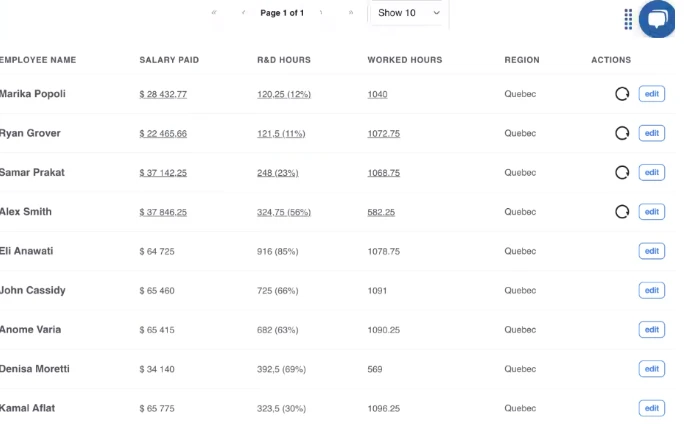
Chrono includes talent matching and on-demand recruitment. Workload visibility shows you where the capacity gap is, then you fill it with vetted engineers or full squads from Chrono’s network. Candidates arrive pre-screened on technical and cultural fit, so ramp-up is short.
Jellyfish tracks engineering activity. When a team is underwater, it will show you that clearly and leave the staffing problem with you.
7. What about infrastructure?
Chrono offers managed cloud services across AWS, GCP, Azure and DigitalOcean. Jellyfish has no equivalent.
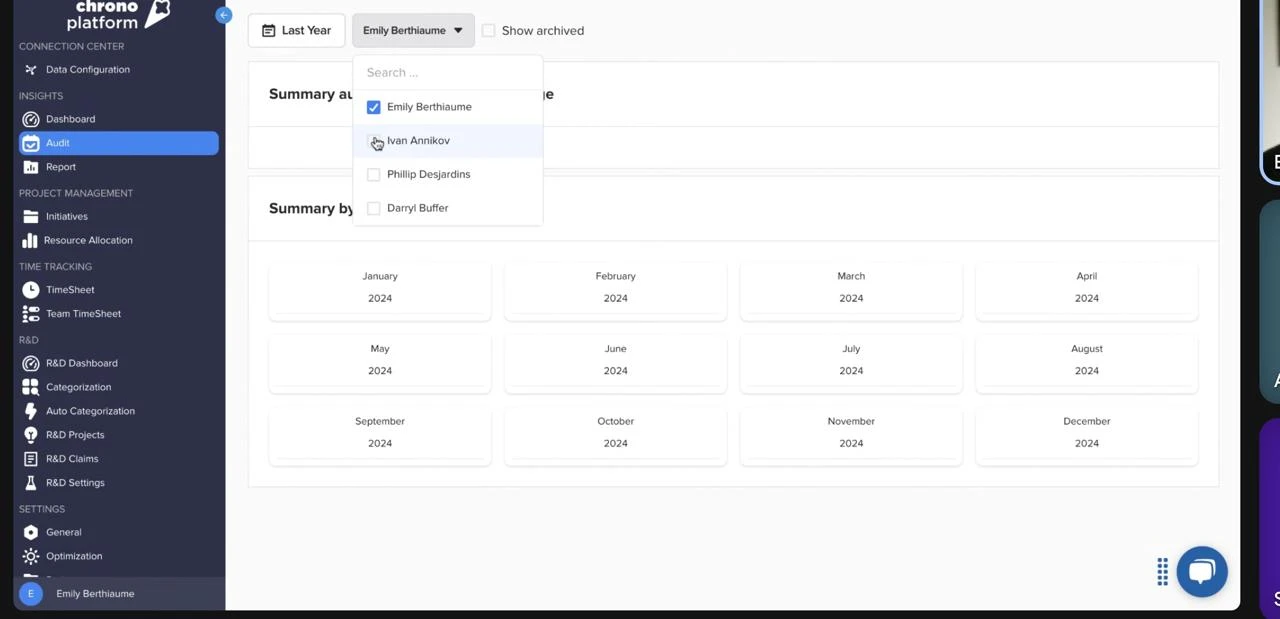
There are two tiers. The Startup tier covers monitoring, alerting and business-hours support. The Scale-Up tier adds 24/7 production response, advanced alerting, custom dashboards and direct DevOps support. Both produce SOC 2 and ISO-ready audit trails.
Because infrastructure, cost and delivery data land in the same platform, you can see how operations affect engineering performance. Fewer audit surprises, cleaner board reporting, and less time spent firefighting instead of shipping.
8. How long does setup take?
Chrono is self-serve. An admin connects Jira, GitHub, Slack or a calendar in minutes, and business rules can change any time.
Jellyfish runs a guided onboarding. That’s the right call for a large enterprise with a complex rollout, and it’s slower if you want to test something this week.
9. Can you try it before you buy it?
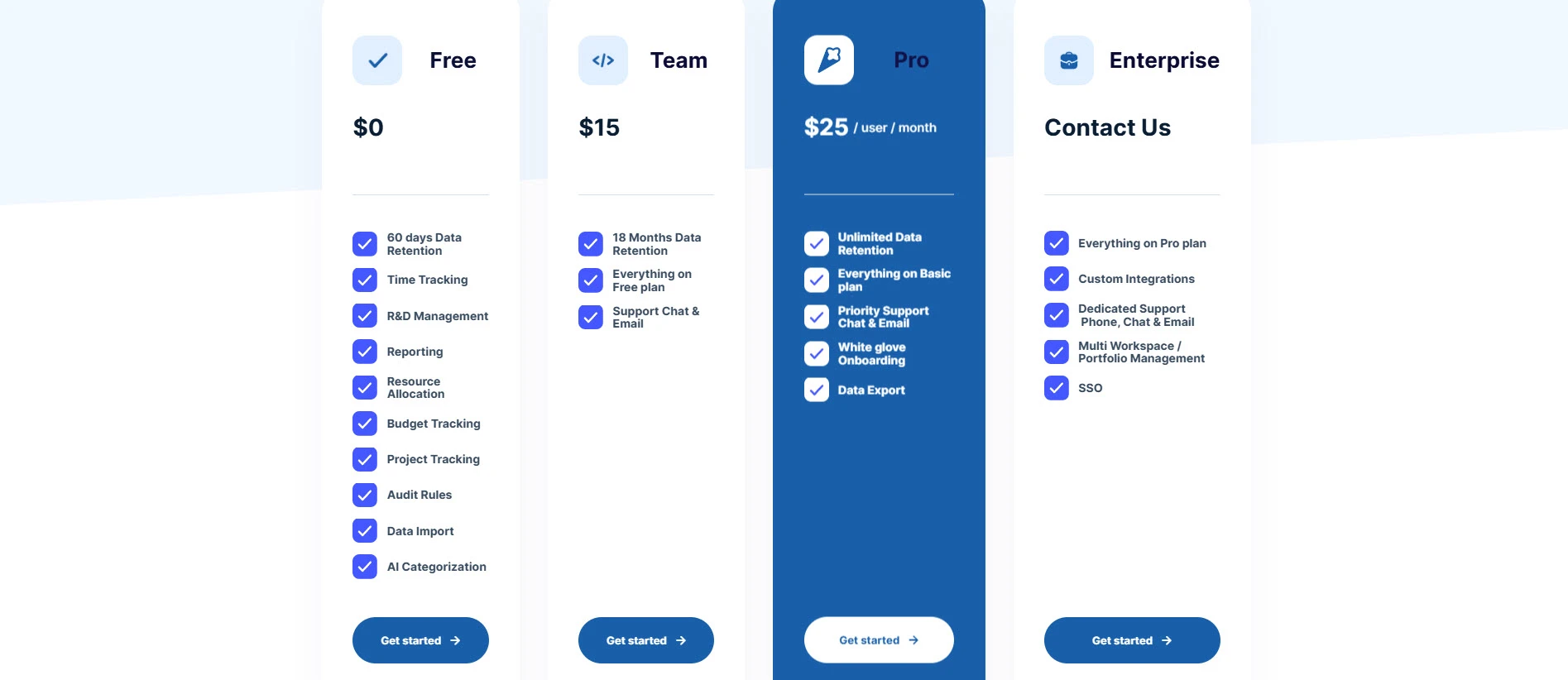
Chrono has a free plan for up to three users. You can test time tracking, R&D work management and reporting, and check whether the integrations actually see your data, before committing budget.
That matters because proving value up front is hard. Deloitte’s 2023 Global Technology Leadership Study found 60% of executives struggle to quantify the benefits of technology investment.
Jellyfish is quote-only and requires a paid commitment from the start. You validate fit after you’ve bought.
10. Does it scale with the team?
Chrono starts small and expands. Compliance automation pairs with capacity on demand, so you can meet a roadmap without permanent hiring.
It connects to Jira, GitHub, Slack, Teams, Asana, Google Calendar and Outlook, with multi-instance support for distributed setups. Business rules update whenever tax regulations or internal policies change, and past work gets reclassified automatically rather than by hand.
Security covers SOC 2 Type 2 and GDPR, which is usually the first question your compliance lead asks.
Which one should you pick?
Pick Jellyfish if you’re a large enterprise that needs engineering activity mapped to organizational OKRs, and your finance team is already handling tax credits elsewhere. It’s a mature product built for that job.
Pick Chrono if you need engineering spend defended with numbers that trace to artifacts, if SR&ED or US R&D credits are material to you, or if you want to start this week without a procurement cycle.
The honest summary: Jellyfish gives you insight into engineering. Chrono gives you evidence you can hand to finance.
FAQ
How does Chrono help with R&D tax credits?
It automates the evidence. Chrono pulls activity from your existing tools, tags each one against eligible tax rules, timestamps it and links it to a contributor. That produces an audit-ready record without anyone filling in a timesheet.
How fast can I get started with Chrono?
Minutes. Setup is self-serve: connect your tools, start with a small team, expand when you’re confident. No consultants and no configuration project.
What makes Chrono different from Jellyfish?
Jellyfish measures engineering activity and estimates ROI from frameworks. Chrono ties that activity to actual costs, tax credits and delivery outcomes, automates SR&ED claims, alerts on risk in real time, and can add engineering capacity.
Can Chrono integrate with our existing tools?
Yes: Jira, GitHub, Asana, Slack, Teams, Google Calendar and Outlook. Activity is captured automatically, so developers get visibility without logging anything manually.
Is there a free plan?
Yes, for up to three users. Track time, manage R&D work and test reporting with no financial commitment, which is enough to check the data quality before you scale.
How does talent matching work?
Chrono provides on-demand capacity from vetted engineers and established squads. Everyone is pre-screened for technical and cultural fit, so they contribute quickly without a full recruitment cycle or permanent headcount.